
The popular advice is to start with a compelling agent demo and scale from there. That approach confuses visible intelligence with operational readiness. An agent that can plan a workflow, call tools, and produce a convincing result in a sandbox may still lack the identity controls, integration boundaries, evaluation discipline, and audit trail required in production.
Agentic AI platforms are becoming enterprise infrastructure, but most organizations aren't struggling to imagine use cases. They're struggling to run autonomous systems safely across imperfect data, legacy applications, changing policies, and real financial or customer consequences. The practical question for a CIO or engineering leader isn't whether an agent can act. It's whether the organization can control, measure, and recover from those actions.
Where Agentic AI Adoption Stands Today
Enterprise headlines often imply that agentic AI is ready for broad deployment. Adoption data suggests a less comfortable picture. McKinsey-related 2026 reporting found that 62% of respondents were experimenting with AI agents, while 23% had scaled an agentic system somewhere in the business. Among organizations valued at more than $1 billion, 40% were scaling AI agents in 2026, up from 27% in 2025 (McKinsey-related 2026 reporting).
The gap between experimentation and scale is the stronger maturity signal. A pilot can rely on manual review, incomplete permissions, inconsistent data, and an informal response to failures. Production requires named ownership, bounded actions, monitoring, incident response, and evidence that shows who did what, when, and with which data.
Adoption is moving faster than control
Usage is also advancing faster than governance. The same reporting found that 82% of organizations already used AI agents, but only 44% had security policies for them. The discrepancy matters because agents can select tools, retrieve sensitive context, update records, trigger workflows, and continue operating across connected systems (McKinsey-related 2026 reporting).
A failure may involve more than an incorrect answer. An agent could take an unauthorized action, change the wrong record, request excessive data, or combine individually plausible decisions into a harmful result. As autonomy increases, leaders must define permitted actions, the identity used for each action, the data available to the agent, and the conditions that require human approval.
Practical rule: Treat the move from pilot to production as a controls project, not simply a deployment project.
Scaling requires operating discipline that demonstrations rarely show. Assign business and technical owners, establish an incident path, retain audit trails for decisions and tool calls, and test how the system behaves when data, permissions, or downstream services fail. Platform evaluations should therefore focus on enforceable boundaries and observable behavior, not only on the fluency of an agent's responses.
What Agentic AI Platforms Actually Do
A standard AI assistant mainly responds to a request. An agentic platform coordinates a workflow. It gives an organization the environment to build, orchestrate, deploy, govern, and operate AI agents, with shared infrastructure for integrations, multi-agent coordination, policies, observability, and guardrails (enterprise agentic AI platform capabilities).
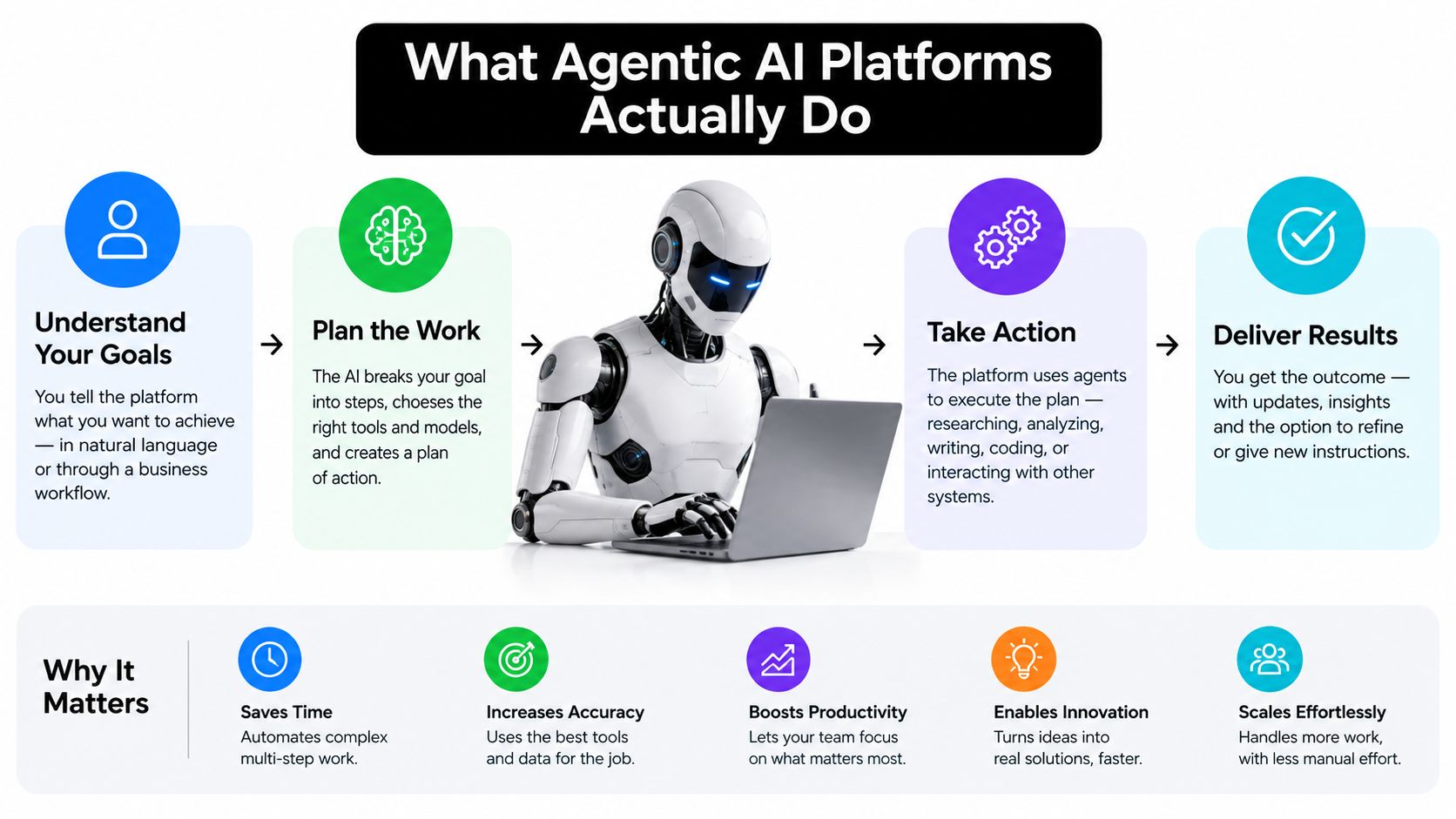
A useful way to evaluate a platform is to separate four functional blocks.
Build the agent and its boundaries
The first block defines the agent's purpose, available tools, instructions, data sources, and escalation conditions. A customer service agent might read an account record and draft a response, while a more autonomous version could initiate a refund or update a case. Those are different risk profiles, even if they use the same underlying model.
The platform should make permissions and action scopes explicit. If a team can't identify which tools an agent can call or which records it can change, the system isn't ready for sensitive workflows.
Orchestrate the plan
The orchestration layer turns a goal into steps. It may route work between specialized agents, retrieve context, choose an API, evaluate a result, and decide whether to continue or escalate. This marks how agentic systems differ from fixed automation. The platform coordinates decisions that weren't fully scripted in advance.
For engineering leaders designing development environments, the open-source AuricIDE architecture offers a useful reference point for thinking about how agents, tools, context, and execution can fit together.
Execute through integrations
An agent becomes operational when it can act through approved interfaces. Those interfaces might include ticketing systems, data services, customer platforms, code repositories, or internal APIs. The quality of the integration layer often matters more than the conversational interface because it determines whether the agent can perform a complete workflow or merely recommend the next step.
Govern and observe the result
The final block applies policies, records actions, monitors outcomes, and supports intervention. It should show what the agent attempted, which tools it called, what information it used, and why the workflow stopped or escalated.
A platform that only generates plans is an assistant. A platform that safely coordinates action across systems is an enterprise operating layer. That's why platform evaluation should begin with the workflow outcome and work backward to models, tools, data, and controls.
The Five Critical Controls for Safe Deployment
Autonomy increases the number of decisions a system can make without a person in the loop. Governance must therefore cover more than model quality. Bain identifies five control areas for agentic platforms: identity, behaviors, context, observability and evaluation, and accountability (Bain's agentic AI governance framework).
Control AreaPrimary PurposeIdentityEstablish which agent is acting, for whom, and with what permissionsBehaviorsDefine allowed actions, prohibited actions, and escalation rulesContextControl the data, policies, and business information available to the agentObservability and evaluationMeasure actions, tool use, outcomes, and failure patternsAccountabilityAssign human ownership for decisions, exceptions, and remediation
Identity comes before autonomy
An agent shouldn't borrow a broad service account just because that makes integration easier. Its identity needs to be distinguishable from human users and other automated processes. Access should reflect the smallest useful scope, and sensitive operations should require stronger approval or additional verification.
This control also clarifies responsibility. If an agent changes a customer record, the organization should know which agent acted, which workflow authorized it, and which owner is accountable for the result.
Behaviors and context define the operating envelope
Behavior controls should specify what the agent may do without approval, what it may propose, and what it must never do. Context controls are equally important. An agent that receives irrelevant, outdated, or overly broad information can make a technically coherent decision from an unsafe premise.
Use curated retrieval, policy-aware prompts, structured tool schemas, and explicit escalation conditions. Don't assume that a more capable model will compensate for poor context design.
Evaluation must inspect the path, not only the destination
A successful outcome can hide brittle execution. An agent may eventually resolve a request after selecting the wrong tool, passing malformed inputs, or making unnecessary calls. Those hidden failures become more consequential in long-running workflows.
Engineering teams should also consider risk management for connected environments, including the interaction between software actions, physical systems, and operational technology. Guidance on simulation and IoT risk mitigation is relevant when agents influence systems beyond a purely digital workspace.
Accountability completes the framework. Every production agent needs a named owner, an approval model, an incident path, and a process for changing its tools or policies. Without those elements, governance remains documentation rather than operational control.
Evaluating Platform Performance and Outcomes
Platform benchmarks often reward the wrong behavior. A high task-completion rate matters, but it doesn't tell you whether the agent used the correct tools, respected instructions, or consumed resources efficiently.
Microsoft separates outcome metrics from process metrics. Task completion, task adherence, and intent resolution assess whether the agent solved the user's problem. Tool-call accuracy, tool selection, and tool-input accuracy assess whether it followed a sound execution path (Microsoft agent evaluators).
Measure the result and the route
A production evaluation suite should include both categories:
- Outcome tests: Did the agent complete the requested task, follow the stated constraints, and resolve the user's intent?
- Process tests: Did it choose the appropriate tool, provide valid inputs, avoid unnecessary calls, and stop when the workflow reached a safe boundary?
- Recovery tests: Did it handle missing data, tool errors, ambiguous requests, and policy conflicts without improvising beyond its authority?
- Operational tests: Did latency, token consumption, and tool-call volume remain acceptable for the business process?
The distinction changes procurement decisions. A platform may look excellent in a demo while failing process tests under incomplete data or tool errors. Conversely, a slightly less impressive interface may prove more reliable because its orchestration, logging, and recovery controls are stronger.
Cost efficiency changes the platform choice
An independent benchmark of agent platforms tested a suite of 10 coding tasks, run three times each. Claude Managed Agents and Vertex AI Agent Engine each completed 30 of 30 tasks, or 100%, while Vertex cost $1.45 and Claude cost $2.50 in that benchmark. The same assessment found that Claude used fewer tokens than the self-hosted control path (independent agent platform benchmark).
Those results don't identify a universal winner. They show why capability, cost, and token economy must be assessed together. A platform that completes tasks reliably but makes excessive calls may be unsuitable for a high-volume workflow. A lower-cost system may create more operational work if its tool selection or recovery behavior is weak.
Run evaluations against your own tools and data. Keep a test set for ordinary requests, edge cases, permissions, unavailable systems, and human handoffs. Production readiness is a repeatable operating profile, not a single impressive score.
Real-World Use Cases Driving Enterprise Value
The strongest enterprise use cases have a clear workflow, accessible data, measurable outcomes, and a manageable risk boundary. They don't begin with a vague goal such as “make the business more intelligent.” They begin with work that currently involves repetitive investigation, multiple handoffs, or slow movement between systems.

A 2026 enterprise overview reports that adopters use agentic AI for customer service automation at 43%, data analysis and reporting at 38%, and code generation or review at about 35%, with productivity gains reported by roughly two-thirds of adopters (enterprise agentic AI use cases).
Customer operations
A customer service agent can retrieve account context, interpret a request, check policy, prepare a response, and update the relevant case. The practical value comes from closing the workflow rather than producing a well-written reply. Human teams should handle exceptions, sensitive decisions, and cases where the available information conflicts.
Advertising operations provide a similar pattern. A team evaluating an agent for campaign research or optimization can browse the NotFair ads agent as a concrete example of how a specialized workflow may interact with advertising data and actions. The evaluation still needs to cover permissions, approval points, and evidence for every recommendation.
Analysis and reporting
Data agents are useful when analysts spend time gathering information, reconciling sources, and preparing recurring explanations. A governed agent can retrieve approved data, apply a defined analytical workflow, identify anomalies, and produce a draft for review. It shouldn't silently redefine business metrics or treat incomplete source data as a complete picture.
In operational environments, the boundary between digital analysis and physical action deserves care. A smart building AI success story illustrates why connected systems require attention to telemetry, controls, and consequences, not only model output.
Code generation and review form another strong category because the workflow can include tests, repository checks, and human approval. The agent can inspect a change, propose modifications, run validation, and create a review artifact without receiving unrestricted production access.
BCG reports that effective AI agents can accelerate business processes by 30% to 50%, with some implementations cutting manual workloads by up to 60% (BCG analysis of agentic AI and enterprise platforms). These figures reinforce an important buying principle: define the process improvement first, then select the agent architecture that can deliver it safely.
Trust remains the limiting factor for broader deployment. Capgemini reported that 14% of organizations had implemented AI agents at partial or full scale, 23% were piloting them, and 71% said they couldn't fully trust autonomous AI agents for enterprise use (Capgemini generative AI research). That gap is why use-case selection and control design must progress together.
Integration Patterns and Infrastructure Considerations
The model is rarely the hardest part of an enterprise agent deployment. Integration is. Legacy systems often weren't designed for agentic interactions, and Deloitte identifies legacy integration as a fundamental obstacle. The same analysis reports that organizations struggle with data searchability at 48% and data reusability at 47% in AI automation strategy (Deloitte's 2026 agentic AI strategy analysis).
An agent can reason well and still fail because an API exposes ambiguous fields, a data catalog is incomplete, or an older application requires brittle screen automation. Platform selection is therefore an architecture decision. The interface and model matter, but so do identity propagation, API quality, event handling, data contracts, observability, and rollback.
Start with a bounded integration surface
Choose one workflow and map every system it touches. Identify the system of record, the read operations, the write operations, data classifications, approval points, and failure states. Create stable APIs or service wrappers where possible, rather than giving an agent unrestricted access to a broad application.
Use structured tool definitions. Each tool should state its purpose, required inputs, expected outputs, authorization requirements, and known failure conditions. That makes tool selection easier to test and reduces the chance that the agent will infer a dangerous action from a vague description.
Design for interoperability
Current platforms don't yet share universally accepted standards for cross-platform agent interaction and governance. Emerging approaches such as MCP and A2A may help connect agents and tools, but teams should treat them as architectural components to evaluate, not as substitutes for access control and testing.
A practical web scraping MCP overview can help teams understand how external data tools fit into agent workflows. The same discipline applies internally: verify provenance, define refresh expectations, restrict collection, and prevent untrusted content from becoming an instruction channel.
Build the operating layer before expanding
Use a shared integration gateway where you can enforce authentication, rate limits, schemas, logging, and policy checks. Keep retrieval separate from action when a workflow involves sensitive decisions. Add human approval for irreversible operations, and design a compensating action or rollback path before granting broader autonomy.
Data architecture also matters. Agents need searchable, reusable, well-described information, not merely more data. Clean ownership, metadata, freshness indicators, and consistent identifiers will improve reliability more effectively than adding another model to an unstable foundation.
Moving from Pilot Projects to Enterprise Scale
Enterprise scale requires a coordinated capability, not a collection of disconnected agents. Start with a bounded workflow, assign identity and accountability, expose only the integrations the agent needs, and evaluate both outcomes and tool behavior. Expand autonomy only after the system demonstrates reliable recovery, traceable actions, and acceptable operating cost.
The market is projected to reach about $139.19 billion by 2034, with a 40.5% CAGR in one estimate (agentic AI market projections). That projection signals momentum, but the immediate executive priority is simpler: build the controls and integration foundation that turns promising automation into dependable business performance.
Choose one workflow with a measurable business outcome and an accountable owner. Faberwork provides agentic AI consulting, workflow mapping, integration development, operational controls, and Snowflake-centered data solutions for organizations that need to move from isolated pilots to governed execution. Start with a production-readiness assessment, map the workflow and its data dependencies, and define the evaluation and approval model before selecting or scaling an agentic AI platform.


