
Your fleet-management agent has finished summarizing overnight vehicle telemetry. It's flagged delayed departures and suggested better routes. Then someone asks whether it can apply those changes, and you realize the same connection that reads vehicle positions can also edit dispatch rules. Can you see what it's about to change, block the request, and stop the agent before it acts?
What Agentic AI Guardrails Are and Why They Matter
The original task sounded harmless: summarize overnight telemetry. But a tool-enabled agent can move from analysis to action if its credentials and connected tools permit it. A recommendation to adjust routes can become a configuration change, even though nobody authorized that change.
Agentic AI guardrails are checks around an agent's plan, tool calls, and data access. They determine what runs automatically, what gets blocked, and what needs a person's approval. Their purpose isn't to produce a safer answer. It's to keep the agent's actions inside an authorized boundary.
A model may propose an action. The surrounding system must decide whether that action is allowed.
A prompt rule is a verbal instruction to a new dispatcher: don't change routing rules without permission. An execution guardrail is the equipment interlock that prevents the wrong lever from moving. Both help, but only the interlock enforces the boundary when someone misunderstands an instruction.
The operational setting makes that distinction concrete.

Why instructions aren't enforcement
A model can misunderstand a request, follow malicious instructions embedded in retrieved content, or choose an inappropriate tool while pursuing a legitimate goal. Repeating a restriction in its prompt doesn't remove the underlying capability.
The EU AI Act establishes a binding governance framework for qualifying systems, including lifecycle risk management, activity logging, human oversight, accuracy, resilience, and cybersecurity. For an enterprise deploying agents, the practical implication is to treat control as an ongoing operating responsibility, not a release checklist.
Prevention and containment serve different purposes. Authorization can prevent an unauthorized routing change. Containment limits damage if another control fails, for example by stopping further calls and preserving evidence for investigation.
Guardrails therefore belong to governance across providers, deployers, data owners, and post-deployment monitoring. They aren't a filter on wording. A useful implementation connects written policy to runtime checks, observable decisions, and a rollout process that proves those controls work.
The Control Layers Every Agent Needs
Use this map to check whether your architecture controls actions throughout the workflow.
Guardrail control layers for agentic systems
Control layerWhat it checksExampleIdentity and permissionsWhich agent acts and with what scopeLogistics agent reads fleet data onlyInput and memory filteringInjected instructions and poisoned memoryPrompts sanitized and memory validated before storagePlan and goal checksWhether the plan matches the signed goalPlan that adds a routing change to a read-only task is blockedTool-call validationAPI target, arguments, and current stateSQL checked for database, schema, row scope, and sensitive columns before submissionAction approvalConsequential or irreversible stepsHuman sign-off before a payment is releasedRuntime monitoringBehavior drift, block rate, and repeated violationsAlert when retries on one tool spikeAudit loggingFull trace of plan, call, decision, and outcomeIncident can be reconstructed step by step
How the layers work together
Start with identity and permissions. The system needs to know which agent is acting and whose authority it represents before evaluating a request. Otherwise, even a correctly formed call may execute under the wrong person's privileges.
Next, separate trusted instructions from untrusted inputs and stored memory. A maintenance note can contain useful information without gaining authority to redefine the agent's task. Plan checks then compare proposed work with the authorized goal.
At execution, validate the tool and its arguments. Correct identity doesn't imply a correct action: an authorized agent can still submit a malformed write, target the wrong customer, or request an excessive date range.
Approval gates constrain consequential actions. Monitoring detects patterns that individual checks may miss, while audit logging preserves evidence across the entire sequence.
Cover risks, not just interfaces
The OWASP AI Agent Security Cheat Sheet identifies distinct risks including tool abuse, privilege escalation, goal hijacking, excessive autonomy, and denial-of-wallet attacks, alongside prompt injection and memory poisoning. Map each relevant risk to an enforcing control rather than assuming a general safety prompt covers it.
For fleet operations, routine telemetry reads can run automatically. Dispatch configuration changes should wait for authorization, while request-volume limits prevent repeated analysis from consuming an uncontrolled budget.
Missing layers create different failures. Without input controls, hostile content can influence planning. Without approval integrity, someone can authorize a harmless preview while the agent executes a changed payload. Without monitoring, repeated blocked attempts can continue unnoticed.
For every layer, require a named owner, written scope, and a recorded decision. A control nobody can explain or demonstrate isn't ready for production.
Example Policies and Reference Architecture
A permission becomes useful when the system can evaluate it without asking the model what it means.
Say a logistics scheduling agent may read vehicle positions, conditionally update dispatch rules, and never change customer notification templates. Translate that policy into predicates:
- Vehicle-position reads: Allow only when the authenticated identity is the scheduling agent and the requested fleet belongs to the task's permitted tenant.
- Dispatch writes: Allow only when the signed task token includes dispatch scope, the approval record is verified, and the approved payload matches the proposed change.
- Notification-template changes: Deny for this agent, regardless of the explanation attached to the request.
For a hypothetical dispatch task, you might also require the credential to expire within four hours. That's an example policy choice, not a universal security standard.
Put enforcement outside the model
Use an identity provider to issue a short-lived, task-scoped credential. Place a policy enforcement gateway between the agent and every tool, API, database, and Model Context Protocol (MCP) server.
Behind that gateway, a policy engine evaluates the signed goal, normalized arguments, approval evidence, and current system state. It returns Pass, Block, or corrective feedback. An append-only audit store records the proposed call, decision, execution result, and correlation identifiers.
Architecture test: If manipulating the prompt can bypass the gateway, the gateway isn't the enforcement boundary.
Downstream systems should reject direct connections that bypass this path. Otherwise, an agent could avoid the policy engine by choosing another available connector.
This separation also applies beyond logistics. In AI-enabled interactive media production, generating an asset and publishing it should have different permissions.
Before release, replay a small acceptance set, for example ten recorded failure or attack cases, against the policies. Confirm that prohibited actions are blocked and logged, while authorized work still completes. Include missing approvals, expired credentials, altered payloads, and attempts to connect directly to a tool.
How to Validate Each Agent Action at Runtime
Validate every consequential step, not just the final answer. By the time an agent reports that it changed dispatch rules, a response filter can't undo the operation.
Operators need visibility into the execution path, not merely the conversation.
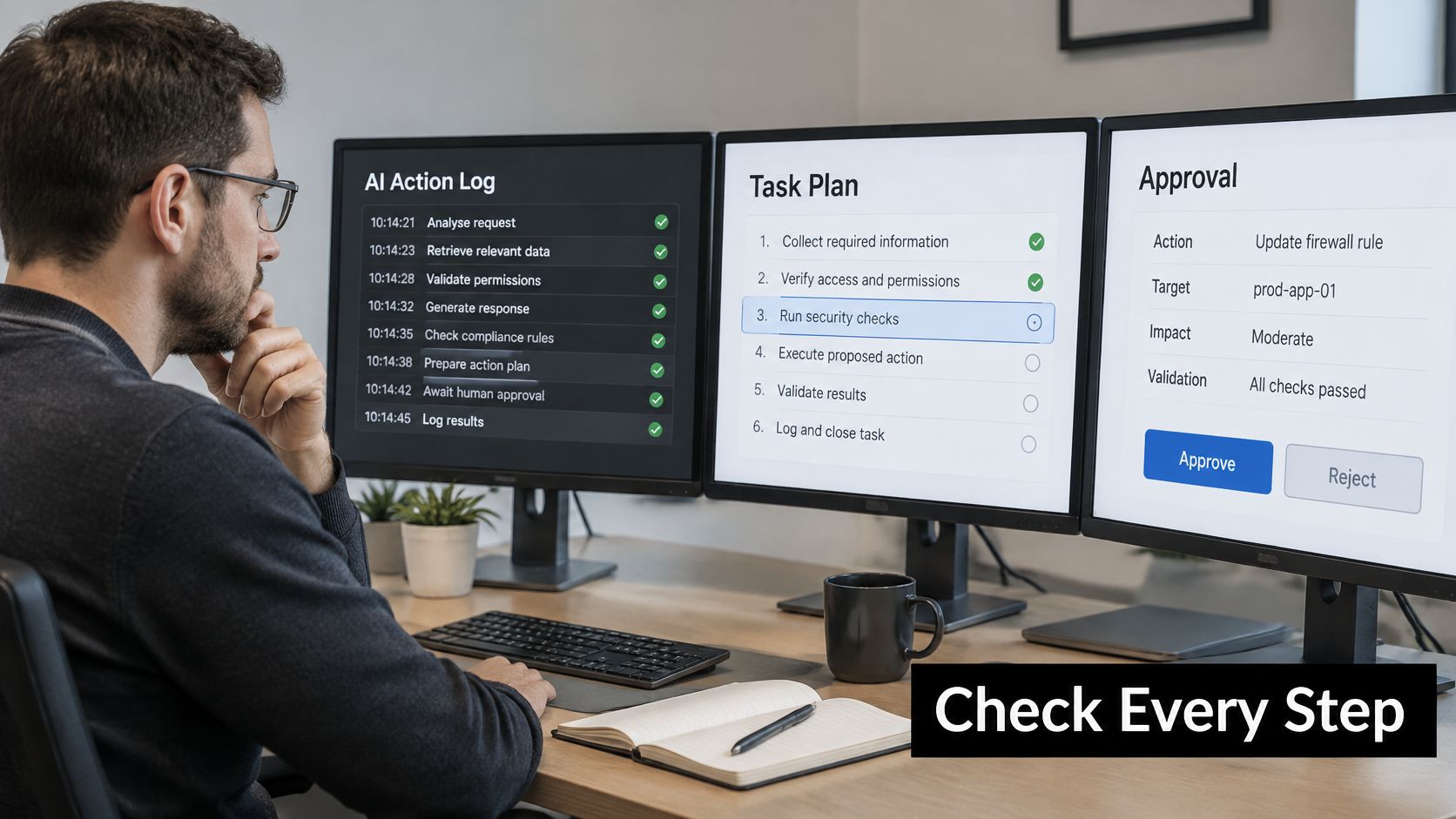
The runtime decision sequence
- Compare intent and action. Check the proposed tool call against the current plan and signed goal. A telemetry summary shouldn't acquire a dispatch-editing step because the model considers it helpful.
- Confirm identity and scope. Verify the agent's credential and authority for this task. Authentication alone doesn't establish permission for the proposed operation.
- Validate arguments. Check the API target, parameter types, date window, row limits, and permitted columns against a schema. Reject ambiguous or out-of-scope values before execution.
- Inspect current state. Confirm that the target record isn't locked and the action hasn't already completed. An idempotency key should prevent a retry from repeating a payment or write.
- Return an explicit decision. Produce Pass, Block, or corrective feedback with a machine-readable reason. Distinguish a fixable formatting error from a forbidden action.
- Bound the recovery attempt. For example, allow one retry for a correctable request, using the feedback. Escalate when that budget is exhausted, and never let retries negotiate away an authorization denial.
- Record the outcome. Log the plan, tool name, normalized arguments, policy decision, retry history, and final result. Protect sensitive values while retaining enough context to reconstruct the event.
Correct safe mistakes without authorizing unsafe work
Suppose a delivery-report request has no date boundary. Under an example reporting policy, corrective feedback can narrow it to a seven-day window. A proposed write to dispatch rules, however, stays blocked unless the required authorization exists.
This distinction matters because read-query corrections and irreversible actions need different recovery paths. For payment workflows, BroLabel's discussion of MPC signing for agent wallets is a useful companion when considering signing authority alongside transaction approval.
Test these paths before exposing operational systems. The same reasoning behind simulation and IoT risk mitigation applies: exercise failure conditions where you can inspect and contain the result.
Use workflow demonstrations to review where checks occur, rather than treating the final answer as proof of safe execution.
The reported GuardianAgentBench implementation recovered 19.9% of failures at a 0.5% false-positive rate, outperforming system-prompt defenses across the evaluated models. That benchmark result isn't a production guarantee. Measure both prevented failures and unnecessary blocks on your own workflows.
Least Privilege and Agent Identity Done Right
Confidence isn't the same as enforced access control. In Cequence's enterprise agent-governance research, 94% of respondents were confident their agents didn't have excessive access, yet only 33% provisioned agents with least-privilege access.
The same research found that only 34% evaluated authorization when an agent attempted a specific action, while 14% allowed unrestricted MCP connections to external tools and data sources. It also reported that 32.9% of surveyed organizations had encountered unauthorized, shadow, or misconfigured MCP servers in the past year.
Resolve the identity questions
Before connecting another tool, establish:
- Whose identity is used? Give the agent a distinct non-human identity. Record the initiating user separately rather than hiding every action behind a shared administrator account.
- When does authority change? Bind permissions to the active task and withdraw them when the task ends, changes, or loses approval.
- Who reviews access? Assign an accountable owner to every API, database, MCP server, and delegated agent connection.
A logistics agent checking route feasibility needs vehicle-position reads. If an approved task later requires dispatch changes, issue temporary write scope for that task alone. Don't preserve that authority for its next telemetry summary.
Govern connections as carefully as credentials
Maintain an approved tool registry with server provenance, permitted operations, data-egress rules, and an owner. Discovery of a new MCP server should trigger review, not automatic trust.
Use short-lived credentials, fixed access-review cycles, and additional reviews after tool or role changes. Tie approval thresholds to transaction value and operational impact. For delegation, ensure a sub-agent receives only the subset of authority needed for its assignment, not its parent's complete privileges.
Emergency revocation must work at agent level. Security operators should be able to revoke the scheduling agent's credential, invalidate its active task tokens, and deny its gateway traffic without disabling unrelated agents.
Test that distinction. Stopping every automation service may contain an incident, but it can also interrupt dispatch operations unnecessarily. Isolated identities make a targeted response possible.
Human Oversight That Works Beyond a Sign-Off Button
A human in the loop isn't automatically an effective safeguard. In the survey discussed by Salt Security, only 12.5% of organizations could trace a complete agent path, and only 17.5% could automatically stop an unexpectedly behaving agent in production.
An approver who can't see tool calls, delegated actions, or data access is reviewing an incomplete account. A polished summary can conceal the very step that needs intervention.
For high-risk systems, Article 14 of the EU AI Act requires oversight that enables people to monitor operation, interpret outputs, remain aware of automation over-reliance, and override or stop the system. Oversight must be proportionate to risk, autonomy, and deployment context.
Approval controls by action risk tier
Action tierExampleControlRead-only analysisSummarize vehicle telemetryAutomatic, loggedReversible internal changeRe-sort a dispatch queueAutomatic, with a rollback windowFinancially consequentialRefund above a set thresholdNamed approver before executionExternally visibleCustomer delivery notificationAction preview and human approvalIrreversible or safety-relatedDispatch configuration or production database writeTwo-person approval and kill switch ready
Show the change, not just the recommendation
These tiers are a proposed enterprise operating policy, not a claim that every listed approval mechanism is legally mandatory. Adjust them to the actual consequences of each workflow.
A useful approval screen shows the proposed action, the plan behind it, the data touched, and the exact change. Bind approval to that payload so later edits require fresh authorization. Put the preview beside a tested stop control and tamper-resistant event history.
Approval is meaningful only when the reviewer can understand and interrupt the action.
For customer communications, Truespeak's discussion of keeping client-facing AI accurate offers a related perspective on human review.
In maintenance operations, an agent may recommend a service-interval adjustment independently. A change affecting safety-critical equipment should reach a qualified engineer who can inspect the telemetry and proposed plan, reject the recommendation, and stop execution.
Regulatory Deadlines and Penalty Exposure
A logistics dispatcher asks an agent to rebook a delayed container. Two weeks later, an auditor asks who approved that change and what the agent was permitted to touch. If the answer lives in a chat log on someone's laptop, the company has a regulatory problem dressed up as an IT problem.
The European Commission's AI Act enforcement guidance sets maximum fines of €35 million or 7% of total worldwide annual turnover, whichever is higher, for prohibited practices. Other breaches can reach €15 million or 3%, depending on the infringement and the offender's role.
Those figures work more like speed limits than a fixed fine schedule. A truck well over the limit does not receive one standard invoice; the penalty depends on the road, the vehicle class and the operator's history. For agents, the equivalent variables are risk classification, whether you build or deploy the system, and which obligation was broken. Legal owns the classification question. Engineering owns the evidence that the control existed and fired.
Plan against the applicable timetable
The Commission's AI regulatory-framework overview publishes the milestone schedule. Three dates shape most enterprise planning.
EU AI Act milestones relevant to agent guardrails
MilestoneDateWho carries itGeneral-purpose AI obligations apply2 August 2025Model providersAnnex III high-risk obligations scheduled to apply2 August 2026Deployers of listed high-risk systems, alongside applicable provider dutiesCertain embedded high-risk systems in regulated products scheduled to follow2 August 2027Makers and deployers of those products, according to their legal roles
Notice that the obligations arrive in waves, so an agent already running today can fall under stricter duties without a single line of code changing. A document agent that sorts vendor invoices looks low risk. Point the same agent at job applications and the deployer lands in Annex III territory. Re-classify when the workflow changes, not only at procurement.
Keep evidence ready for review
Separate provider duties from deployer duties. Assign ownership across legal, security, data governance and operations rather than placing every obligation with the model team. Providers of general-purpose models presenting systemic risk carry evaluation, adversarial-testing, serious-incident and security responsibilities. Deployment teams carry something different: proof that their own workflow controls operate in production.
Framework guidance such as NIST's Generative AI Risk Management Profile calls for regular review of security and safety guardrails, particularly in novel operating conditions, plus tracking of policy violations, takedown requests and intellectual-property complaints.
Rollouts usually stall at this point. Teams collect plenty of logs but cannot answer whether a refused action would have executed under a different permission set. The audit test is whether you can test, measure, log and revise the control, then point to a specific unauthorized action that was stopped. A policy document proves intent. A replay of a blocked dispatch write proves control.
Start Your Guardrail Rollout This Quarter
A 2025 Harvard Business Review Analytic Services survey of 603 business and technology leaders worldwide found that only 6% of companies trusted AI agents, as Fortune reported. Separately, 55% of surveyed enterprise IT security leaders weren't fully confident they had appropriate deployment guardrails in Salesforce Research's 2025 findings.
The gap shows up at runtime. The controls that matter are the ones an agent hits at the moment of action: a denied tool call, a scoped token that expires, a trace that shows which data the agent read before it wrote. A policy binder cannot produce any of those.
Start with a bounded rollout rather than an enterprise-wide policy rewrite.

A practical quarterly sequence
- Inventory production agents. Record tools, identities, write permissions, and owners. A logistics team might discover a forgotten dispatch-write token on an old scheduler and revoke it immediately.
- Classify actions by consequence, including reversibility, financial exposure, customer visibility, and safety impact.
- Remove standing write access. Replace it with task-scoped credentials and explicit expiry.
- Put validation and logging before tool execution. Start with the connectors that can change operational systems.
- Exercise approval and stopping paths. Test consequential-action gates and controlled interruption against a running agent.
- Track block rate, false-positive rate, incident recovery time, and the time needed to reconstruct an agent path.
- Repeat after changes. Re-run acceptance tests whenever tools, models, prompts, or permission policies change.
Inventory before scale
Gartner projects that guardian agents, which monitor and control other agents, will capture 10 to 15% of the agentic AI market by 2030. That forecast points to a practical problem: an inventory becomes harder to reconstruct after teams distribute ownership across applications and departments.
Define completion through demonstrated outcomes: an unauthorized write fails, an approved task completes, an operator can stop execution, and an investigator can reconstruct what happened.
This week, list every production agent, its write permissions, and its named owner. If you need help turning that inventory into an implementation plan, work with us at Faberwork LLC. We offer AI advisory, use case practices, and model development and deployment, and design LLM applications, AI agents, RAG pipelines, and workflow automation to help businesses optimize operations, improve customer engagement, and pursue growth opportunities. Bring one operational workflow and its tool inventory so we can define the controls it needs before expanding its autonomy.


