
44% of surveyed companies are already deploying AI agents in narrow functional areas, according to the SAP LeanIX Agentic AI Survey 2026. Yet adoption alone doesn't create reliable automation. A CTO can approve an agent that reads support tickets, checks inventory, and drafts a resolution, then discover that the system can't explain which data it used, why it called a particular API, or how a human can reverse its action.
That gap defines agentic AI architecture. The architecture connects models, tools, data, memory, orchestration, security, and human oversight so an AI system can pursue a goal without becoming an uncontrolled collection of prompts and integrations. The strongest designs focus on outcomes, such as faster resolution, safer approvals, better operational visibility, or more consistent execution.
Introduction to Agentic AI Architecture
A technology leader evaluating an agentic workflow usually starts with a business request: reduce service backlog, automate claims intake, reconcile operational records, or help employees act on live data. The request sounds simple until the system must retrieve current information, select a tool, handle failure, preserve context, request approval, and leave an audit trail.
That's why an agentic system needs more than a capable language model. It needs a dependable execution environment around the model, with clearly bounded permissions and observable decisions.
The 44% adoption figure from SAP LeanIX describes deployment in narrow functional areas, not universal enterprise-scale autonomy. That distinction matters. A focused agent with a limited toolset is easier to test and govern than one that can make changes across finance, customer operations, and infrastructure.
Practical rule: Start with an outcome and a bounded workflow, not with a model or an agent framework.
Leaders who want a plain-language foundation can begin with SupportGPT's AI agent guide, then translate the definition into architecture decisions. The practical question is whether the proposed system can complete a useful task reliably, show its work, protect sensitive data, and escalate when confidence or authority runs out.
Understanding Agentic AI Architecture and Goals
Agentic AI architecture represents a shift from generating an answer to executing a workflow. A conventional chatbot may summarize an order policy. An agentic workflow can identify a customer request, retrieve the relevant account record, check current order status, prepare a response, and route an exception for approval.
The field's recent momentum reflects that change. The 2025 AI Agent Index reports that papers mentioning “AI agent” on Google Scholar exceeded all prior years combined. The same index reports that 24 of 30 tracked agents were launched or received major agentic updates during 2024 and 2025, while enterprise platforms appeared later than chat agents. Together, those signals show the center of gravity moving toward business automation and tool-using workflows.
AWS describes the rise as a convergence between distributed software-agent architectures and transformer-based large language models. Milestones such as Anthropic's Claude 3.7 Sonnet in February 2025, described in the AWS guidance as the first hybrid reasoning model on the market, and the wider adoption of the Model Context Protocol helped turn architectural ideas into productized capabilities.
The four outcomes that justify the architecture
A useful system should pursue four outcomes:
- Persistent context: The agent can retrieve relevant history and current state rather than relying only on the active prompt.
- External action: The agent can call approved APIs, databases, workflow systems, or business applications.
- Autonomous execution: The system can sequence steps, inspect results, retry safely, and stop when the task is complete.
- Measurable business impact: Leaders can connect the workflow to quality, cycle time, cost, risk, or customer experience objectives.
Define the success measure before selecting components. If the desired outcome is safer case handling, measure approval quality and traceability. If it's faster operations, measure end-to-end completion and phase-level latency. Architecture becomes easier to evaluate when the business result is explicit.
Core Components of Agentic AI Systems
A reliable agentic system resembles a well-run operations team. Each participant has a role, access to specific information, authority to perform certain actions, and a process for handing work to someone else.
The reasoning and action layer
The model interprets a goal, weighs available context, and proposes the next step. It shouldn't own unrestricted authority. The model is closer to a coordinator who recommends an action than an employee who can access every system.
The agent runtime turns that recommendation into a loop. It receives an input, chooses a step, invokes a tool, evaluates the result, updates state, and continues or escalates. A customer-support agent might retrieve an order, inspect its delivery status, and draft a response, while a separate policy service determines whether a refund is permitted.
Tools connect the agent to the environment. They can include approved database queries, internal APIs, search services, workflow engines, code execution, or business applications. Each tool needs a clear contract, input validation, output validation, authentication, and a narrow permission scope.
Planning, memory, and coordination
A planner decomposes a broad goal into smaller tasks. For an equipment-maintenance request, it might identify the asset, retrieve its service history, check current telemetry, and prepare a work-order recommendation.
An executor performs those tasks. Keeping planning separate from execution helps teams test whether the agent selected the correct sequence independently from whether a tool returned the correct result.
Memory preserves useful context. Short-term memory holds intermediate results in the current run. Long-term memory stores durable information that the organization has approved for reuse. Retrieval must be selective, permission-aware, and tied to the current task. A large memory store without reliable retrieval can make reasoning noisier rather than better.
Orchestration manages handoffs, shared state, retries, timeouts, and completion conditions. In a multi-agent system, it also decides which specialist receives a task and how the system combines their outputs.
Safety and accountability
Guardrails sit across the entire workflow. They can restrict tools, validate data, detect policy violations, require human approval, and record decisions. A production agent should also support rollback or compensation when an action changes business state.
A practical component checklist includes:
- Goal and state: Define what completion means and what state must persist.
- Model and planner: Separate reasoning from deterministic business rules.
- Tools and environment: Expose only the systems required for the task.
- Memory and retrieval: Supply current, relevant, permissioned context.
- Orchestrator: Control sequencing, delegation, retries, and escalation.
- Guardrails and audit: Validate actions and preserve a trace of what happened.
The pieces work as one system. If the agent has excellent reasoning but stale data, it acts on the wrong context. If it has accurate data but broad permissions, it can take unsafe actions. If it has both but no traceability, operators can't diagnose failures.
Common Agentic AI Architecture Patterns
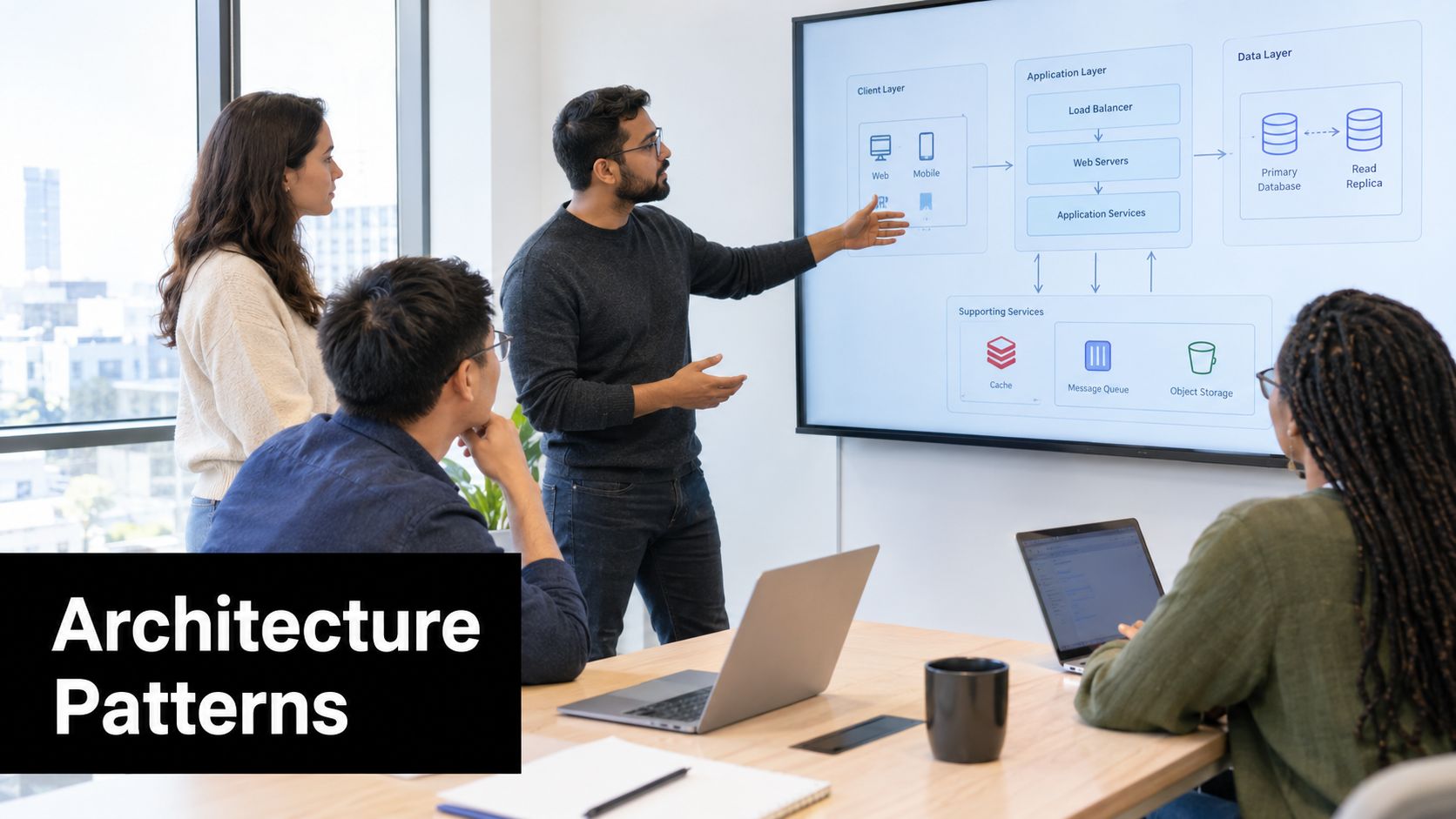
Architecture patterns should follow the workflow's shape. A single-agent loop may suit a focused support assistant, while a cross-functional process may need routing, specialization, or independent verification.
Choosing the right shape
PatternBest fitMain advantageMain trade-offSingle agentNarrow support or research taskSimple evaluation and controlLimited specializationSequential pipelineDependent processing stepsClear handoffs and traceabilityLater steps wait for earlier resultsParallel agentsIndependent subtasksWork can proceed concurrentlyResults need aggregationRouterDistinct request categoriesSends work to the right specialistMisrouting needs detectionCompetitive patternMultiple candidate solutionsAdds evaluation and selectionIncreases resource useHierarchical patternComplex cross-functional workClear delegation and accountabilityMore coordination overheadNetwork patternPeer collaborationFlexible specialist interactionHarder to observe and govern
A single agent is usually the responsible starting point for document classification, approved knowledge retrieval, or customer questions that require current order information. It keeps the state model small and makes tool behavior easier to inspect.
A sequential design works when each output becomes the next input. For example, a retrieval step can gather records, an analysis step can structure them, and an interpretation step can produce an explanation. This arrangement makes failures easier to localize.
Parallel agents suit independent work, such as examining separate operational signals. The orchestrator must still reconcile differences and define what happens when one branch fails.
A router fits customer operations where billing, technical support, and account questions require different tools and policies. The routing decision becomes a governance boundary, not just a convenience.
When multi-agent complexity pays off
Multi-agent systems make sense when specialization, verification, or coordination solves a real failure mode. A compliance workflow may use separate agents for intake and retrieval, while deterministic services handle policy checks. An IoT operations workflow may use one specialist for telemetry, another for maintenance history, and an approval service for proposed changes.
Bain describes a progression from information retrieval agents, to single-task workflows, to cross-system orchestration, and finally multi-agent constellations. That progression is a useful maturity guide, but it isn't a mandate to build the most complex design first.
Teams evaluating collaboration models can explore AI agent orchestration to understand how specialized agents exchange work. The decision should still begin with the workflow's dependencies, risk, and observability requirements.
Use multi-agent architecture when it removes a known constraint. Otherwise, a simpler agent with strong tools and controls is usually easier to operate.
Integrating Agentic AI with Snowflake Data Platforms
Many teams treat model selection as the central architecture decision. In practice, an agent often fails earlier because it can't find, reuse, interpret, or permission the data required at runtime.
Deloitte reports that 48% of organizations cited data searchability and 47% cited data reusability as challenges to their AI automation strategy. The same guidance identifies friction in ETL- and warehouse-centric architectures when agents need current context and actionable access. These figures point to a data-substrate problem, not solely a model problem.
Snowflake can support the context layer when teams expose data through governed interfaces rather than handing an agent unrestricted warehouse access. Secure views can present task-specific records. External functions can connect approved operations to services outside Snowflake. Event tables can support operational traces and agent activity analysis. Together, these capabilities help teams separate data access from model reasoning.
Enterprise Data Readiness Challenges
ChallengePercentage of OrganizationsImpactSearchability of data48%Agents may miss relevant records or rely on incomplete contextReusability of data47%Teams rebuild pipelines instead of sharing trusted data products
Source: Deloitte's agentic AI strategy guidance.
A practical Snowflake workflow might retrieve a customer's current status through a secure view, combine it with recent events, and pass only the necessary fields to the agent. The agent can then call an approved action tool, while Snowflake retains governed records for analysis and audit.
A useful data contract
Define each agent-facing data product with:
- Ownership: Identify who maintains the source and resolves quality issues.
- Lineage: Record where fields originated and how transformations changed them.
- Freshness: State whether the workflow needs current events, recent snapshots, or durable history.
- Permissioning: Enforce access before context reaches the model.
- Reusability: Publish stable interfaces so multiple workflows can use the same trusted data.
Organizations assessing implementation support can review collaborating with Faberwork as a Snowflake partner alongside their internal platform capabilities. The architectural principle remains the same: make trusted data easy for the agent to retrieve, difficult to misuse, and visible to operators.
Design Trade-offs and Non Functional Considerations
Autonomy creates operational responsibility. Once an agent can call tools, update records, or trigger workflows, quality alone isn't enough. The system must show what it did, enforce what it may do, and provide a safe response when its plan fails.
Bain's guidance on agentic AI foundations emphasizes embedded observability, security, governance, traceability, and anomaly detection. These capabilities belong in the architecture from the first deployment, not in a later compliance project.
Governance models
A centralized model gives one platform or governance team responsibility for standards, identity, evaluation, and lifecycle control. It offers consistency, though delivery teams may wait for central approval.
A federated model lets business or domain teams operate their own agents under shared principles. It can fit organizations with strong domain expertise, but teams need common interfaces and audit requirements.
A hybrid model centralizes identity, policy, logging, evaluation, and platform services while allowing domains to build workflow-specific agents. For many enterprises, this balances control with delivery speed.
Latency, cost, and verification
Every additional reasoning step, retrieval call, or agent handoff can increase latency and resource consumption. Independent clinical benchmarking found that tested planner-executor-verifier systems used more than 10 times the tokens and more than twice the latency of baseline LLMs, while producing only modest gains over those baselines. The same study reported that in-agent safeguards filtered 89.9% of hallucinations, yet hallucinations remained prevalent, so verification reduces risk without eliminating it. The clinical benchmarking study supports a cautious design stance.
Measure the workflow by phase, not only by fleet average:
- Input processing
- Context and memory retrieval
- LLM inference
- Tool invocation
- Output generation
- Inter-agent coordination
- End-to-end completion
Track p50, p90, and p99 latency for each phase. This exposes the slow tail, which often comes from retrieval, downstream systems, or coordination rather than the model.
Governance principle: Every consequential action needs a defined authority boundary, an audit record, and a recovery path.
Teams managing risk can also review managing technical debt in risk control. The central decision is how much autonomy a workflow deserves. Start with constrained actions, observable execution, narrow permissions, rollback paths, and human approval gates. Expand autonomy only after the controls demonstrate that the workflow behaves acceptably under real operating conditions.
Implementation Guidance and Reference Architectures
A production reference architecture should make the execution loop visible:
- Input processing receives the request, authenticates the caller, classifies the task, and applies basic validation.
- Context retrieval queries governed memory and data products, including Snowflake views or event-backed operational records.
- Planning and inference selects the next step using the approved context and available tools.
- Tool invocation executes a validated API, database operation, search request, or workflow action.
- State update records the result, updates short-term memory, and preserves relevant durable context.
- Verification checks output format, policy requirements, and business constraints.
- Approval or escalation pauses the workflow when authority, confidence, or risk thresholds require a person.
- Output generation returns the result and the trace needed for operators and auditors.
A practical deployment blueprint
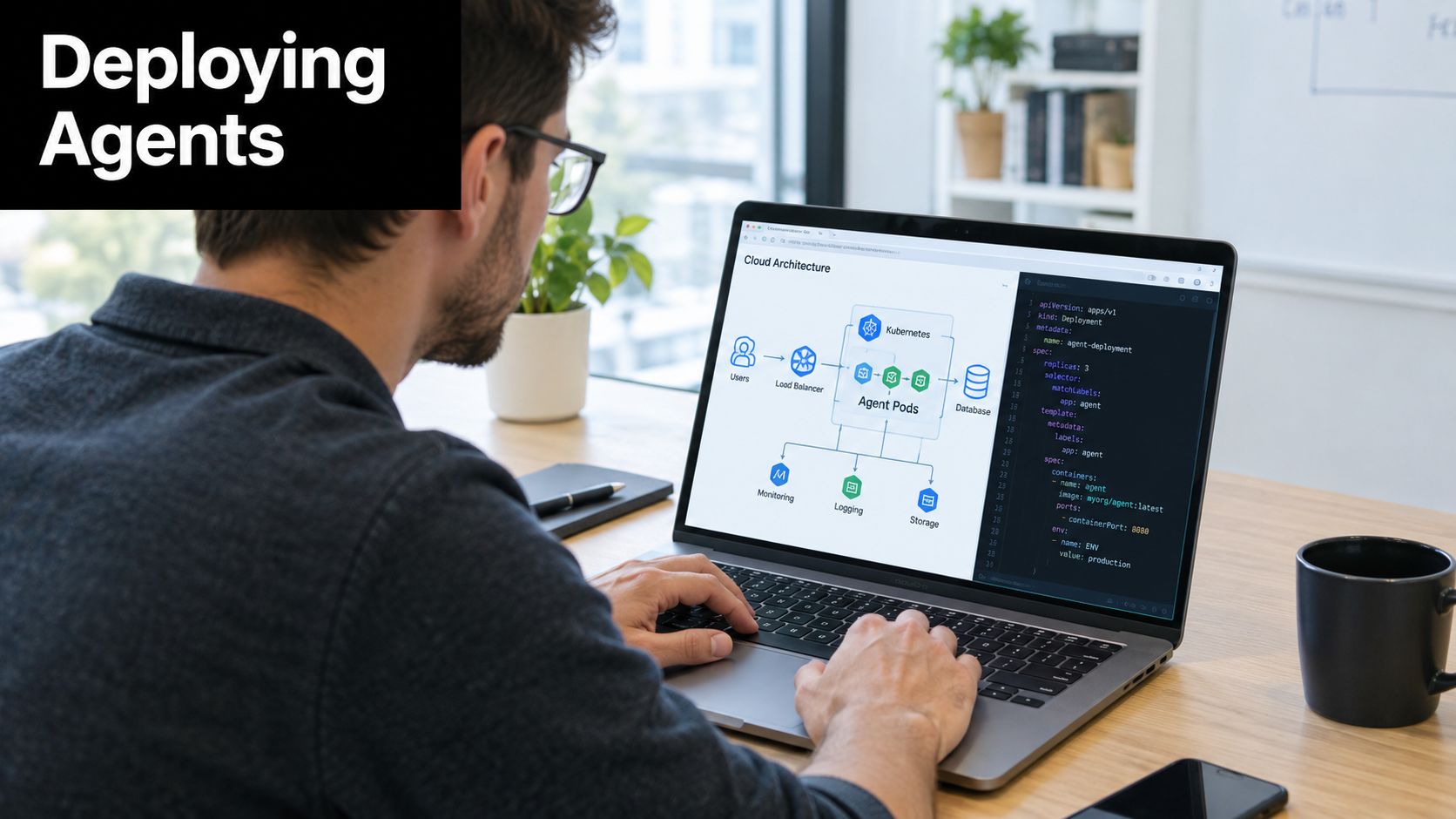
Keep the user-facing interface separate from the agent runtime. An application or service authenticates the user, sends a structured request, and receives a status or result. The runtime manages planning, state, tool calls, retries, timeouts, and escalation.
Place a policy layer between the runtime and business tools. It should verify identity, data entitlements, allowed operations, and input schemas. A tool that retrieves an order can have read access, while a tool that changes an order may require a distinct permission and an approval event.
Use Snowflake as a governed context and analytics layer where appropriate:
- Secure views expose only fields needed for the workflow.
- External functions connect approved actions to external services.
- Event tables and related telemetry support trace analysis.
- Data contracts document ownership, lineage, freshness, and access rules.
A concise logical diagram looks like this:
User request → API gateway → Agent runtime → Context service → Snowflake data products
Agent runtime → Policy layer → Approved tools and business systems
Agent runtime → Trace store → Evaluation, monitoring, audit, and cost analysis
The runtime should emit a correlation identifier for each task. Record the request class, retrieved context references, model invocation, tool name, validated inputs, tool response status, retries, approvals, and final outcome. Avoid storing sensitive content indiscriminately. Log enough to reconstruct behavior while respecting data-minimization requirements.
Instrumentation that finds the real bottleneck
Production optimization should rank phases by their contribution to total latency and addressable variance. The production latency research recommends using real production traces to capture concurrency effects, prompt-mix variance, and downstream contention rather than depending only on synthetic tests.
Create dashboards for:
- Phase latency: p50, p90, and p99 for retrieval, inference, tools, coordination, and the full request.
- Reliability: Tool failures, timeouts, retries, escalations, and incomplete workflows.
- Quality: Evaluation outcomes, policy violations, groundedness checks, and human corrections.
- Resource use: Token consumption and expensive or repeated tool calls.
- Governance: Permission denials, approval waits, rollback events, and anomalous behavior.
A slow workflow shouldn't automatically receive a faster model. First identify whether a secure view is scanning unnecessary data, an external function is waiting on a downstream service, or an agent is repeating a failed call. Phase-level traces make that diagnosis possible.
A walkthrough of deployment practices can complement the written blueprint:
A controlled rollout sequence
Begin with a narrow workflow whose outcome and authority boundary are clear. Test it against representative production traces, including incomplete inputs, stale records, denied permissions, tool failures, and ambiguous requests.
Then introduce one additional capability at a time. Add a new tool only after its contract and audit behavior are established. Add a second agent only when specialization or verification solves a demonstrated problem. Keep a human approval step for consequential changes until the team has evidence that automation can operate safely within defined limits.
Faberwork LLC is one example of a technology partner that works across agentic AI, custom software, and Snowflake-centered data solutions. Whether an organization uses an external partner or builds internally, the engineering standard should remain outcome-focused, measurable, and governed.
Conclusion and Next Steps
Successful agentic AI architecture separates responsibilities clearly. Models reason, tools act, Snowflake and other governed platforms provide context, orchestrators manage state, and control layers enforce authority. Pattern selection should follow workflow complexity, not enthusiasm for multi-agent design.
Start by choosing one bounded business outcome. Map its data sources, tools, approval points, failure modes, and completion criteria. Instrument every phase from input processing through final output, then evaluate real traces before expanding scope.
For leaders planning broader automation, resources on scaling AI employees for business can provide additional perspective on operational adoption. The immediate next step is simpler: select one workflow, document its control boundary, expose only the required data and tools, and run a governed pilot with measurable success criteria.
Choose a high-value, bounded workflow this week, bring its owners and security team into the design review, and build the first agent around trusted Snowflake context, narrow permissions, human approval, and full phase-level tracing.


